| 속성 | 역할 | 권장 개수 |
|---|---|---|
| Research Theme | 최상위 연구 축 | 노트당 1개 |
| Domain | 구체적인 연구 분야 | 노트당 1~3개 |
| Methods | 사용하거나 다룬 기술 | 제한 없음 |
| Type | 문서 형식 | 1개 |
| Status | 작성 상태 | 1개 |
| Related Project | 연결된 프로젝트 | 0~2개 |
Paper Information
Title: Learning Transferable Visual Models From Natural Language Supervision
Authors: Alec Radford, Jong Wook Kim, Chris Hallacy, Aditya Ramesh, Gabriel Goh, Sandhini Agarwal, Girish Sastry, Amanda Askell, Pamela Mishkin, Jack Clark, Gretchen Krueger, Ilya Sutskever
Affiliation: OpenAI
arXiv ID: 2103.00020
Topic: Vision-Language Learning, Contrastive Learning, Multimodal Learning, Zero-Shot Learning, Transfer Learning
Venue: ICML 2021 (Proceedings of the 38th International Conference on Machine Learning, PMLR Vol. 139)
Pages: 8748–8763
1. One-line Summary
CLIP은 대규모 image-text pair를 contrastive learning으로 학습해, 자연어를 통해 새로운 visual concept를 zero-shot으로 인식할 수 있게 만든 vision-language model입니다.
2. Problem
State-of-the-art computer vision systems are trained to predict a fixed set of predetermined object categories. This restricted form of supervision limits their generality and usability since additional labeled data is needed to specify any other visual concept.
기존 vision model은 ImageNet처럼 미리 정해진 class label을 예측하도록 학습됩니다. 그래서 새로운 개념이나 task가 생기면 다시 labeled dataset을 만들고 fine-tuning해야 합니다.
CLIP은 이 문제를
“class label 대신 자연어 자체를 supervision으로 쓰자”
라는 방향으로 해결합니다.
3. Method
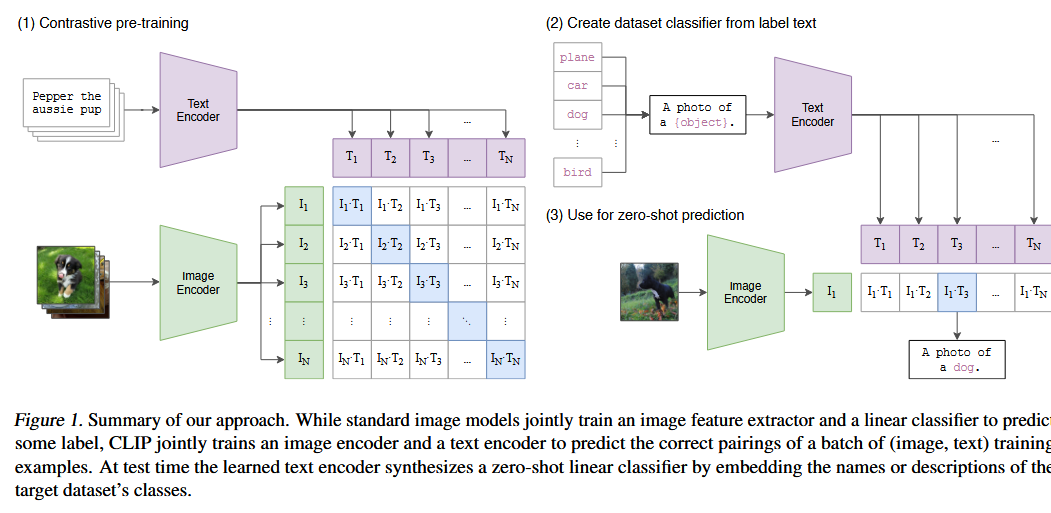
CLIP은 약 4억 개의 image-text pair를 사용합니다.
- Image Encoder: ResNet 또는 ViT
- Text Encoder: Transformer
- 목표: 실제로 짝이 맞는 image-text embedding은 가깝게, 틀린 pair는 멀게 학습
즉 caption을 직접 생성하는 것이 아니라,
Which text matches this image?를 맞히는 contrastive task를 사용합니다.
4. Key Idea
Source: Original Document
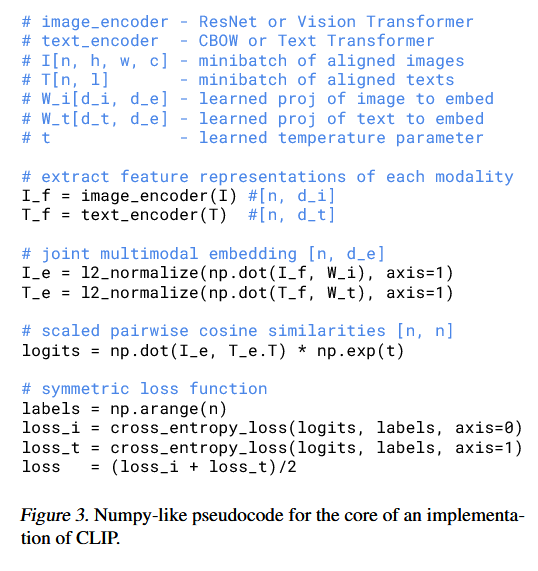
l2_normalize : 이미지 encoder와 텍스트 encoder가 처음에는 서로 다른 형태의 feature를 만들기 때문에, 둘을 직접 비교할 수 없어서 같은 좌표계로 옮기는 과정 (차원이 다르므로 먼저 둘 다 W가 표현가능한 차원으로 옮긴다.)
💡 scaled pairwise cosine similarities 구하는 과정
Cosine Similarity는 두 벡터가 방향상 얼마나 비슷한지를 측정
두 임베딩 벡터를 준비합니다.
두 벡터의 dot product를 구합니다.
각 벡터의 크기를 구합니다. (그런데 CLIP 과정에서는 사전에 이미 l2normalize를 했으므로 크기는 1이 된다.
dot product를 두 벡터 크기의 곱으로 나눕니다.
1: 같은 방향 → 매우 유사
0: 직교 → 관련이 거의 없음
−1: 반대 방향 → 매우 다름
가 됩니다. 즉 정규화된 image embedding과 text embedding의 dot product만 계산하면 cosine similarity가 됩니다.
학습을 통해 이 256차원 공간에서 (W의 차원이 256 차원이라고 할때)
dog image와 "a dog"는 가까워지고, dog image와 "a car"는 멀어지고 , , 그리고 두 encoder 자체가 같이 조정된다. * 다시 말해 W는 정답 image-text pair의 similarity가 높아지도록 학습 과정에서 같이 업데이트되는 parameter
💡 cross entropy란 무엇인가?
Entropy
: 확률분포가 얼마나 불확실한지를 나타내는 값
확률분포 *이때 분포라고 하지만 그냥 각 클래스(사건)에 대한 확률들을 벡터로 표현한 것이다. 에 대해 엔트로피는
Entropy는 하나의 분포 자체의 불확실성을 봅니다.
반면 Cross Entropy는 정답 분포 를 예측 분포 로 표현했을 때 얼마나 잘 맞는지
Cross Entropy
정답 분포를 , 모델의 예측 확률 분포를 라고 하면,
: 클래스 수
: 실제 정답 분포
: 모델이 예측한 클래스 의 확률
분류에서는 보통 정답이 one-hot 형태이므로, 정답 클래스가 k라면
이기 때문에 따라서 식은 사실상
정답 클래스에 모델이 얼마나 높은 확률을 줬는지만 본다
왜 log인가?
정답 분포?
simple pre-training task of predicting which caption goes with which image is an efficient and scalable way to learn SOTA image representations from scratch on a dataset of 400 million (image, text) pairs collected from the internet. After pre-training, natural language is used to reference learned visual concepts (or describe new ones) enabling zero-shot transfer of the model to downstream tasks.
이 논문의 핵심은 단순히 multimodal model을 만든 것이 아니라,
Natural language can act as an open-ended supervision space.
기존 label은 dog, cat, car처럼 class space가 고정되어 있지만, 자연어는 새로운 concept를 거의 제한 없이 표현할 수 있습니다.
그래서 학습 후에는 새로운 dataset에 대해 별도의 classifier를 학습하지 않고
"a photo of a dog""a photo of a cat""a photo of a car"
같은 text embedding과 image embedding의 similarity만 비교해서 classification을 수행할 수 있습니다.
⇒ 크롤링을 통해 수집한 인터넷 이미지와 caption을 활용하여 이미지와 언어간의 연관성을 학습한다. 이렇게 학습한건 Zero-shot에서도 경쟁력있는 성능을 보여준다.
5. Result
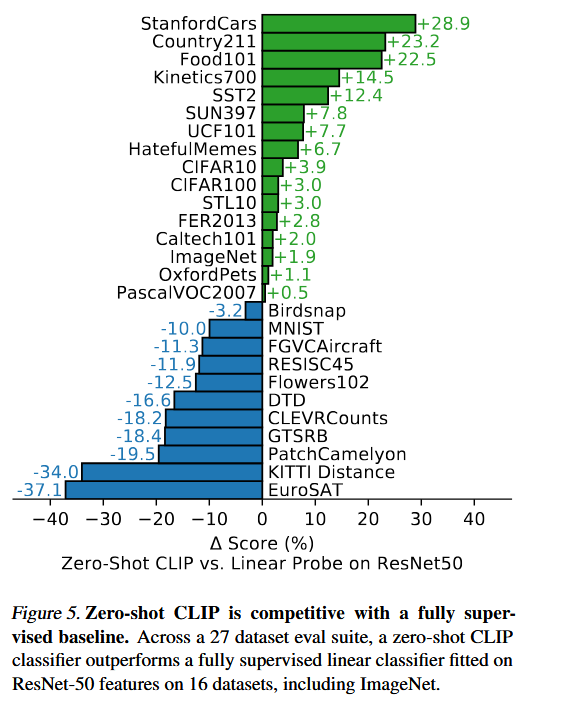
The model transfers non-trivially to most tasks and is often competitive with a fully supervised baseline without the need for any dataset specific training.
Source: Original Document
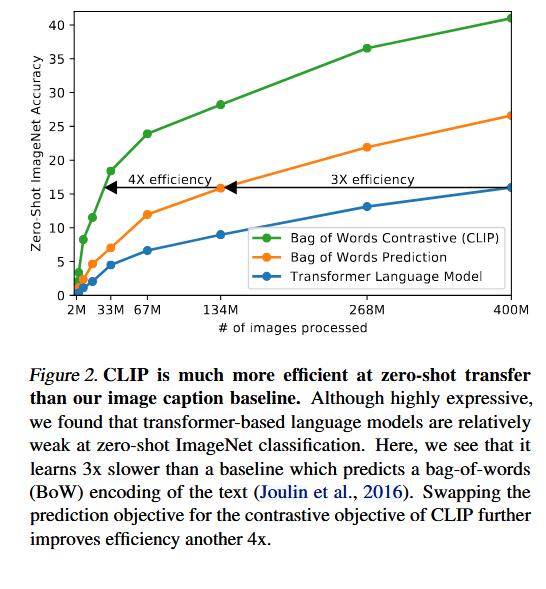
CLIP은 dataset-specific fine-tuning 없이도 여러 benchmark에서 의미 있는 zero-shot 성능을 보였습니다.
Source: Original Document
특히 ImageNet에서는 zero-shot CLIP이 supervised ResNet-50과 비슷한 수준의 accuracy를 보였습니다.
💡 zero-shot은 무엇인가?
Zero-shot은 downstream task의 정답 라벨이 붙은 training example을 하나도 사용하지 않고 새로운 task를 수행하는 설정이다.
CLIP에서의 Zero-shot
CLIP은 ImageNet을 평가할 때 ImageNet training set으로 classifier를 다시 학습하지 않는다.
대신 class name을 자연어 prompt로 바꾼다.
"a photo of a dog"
"a photo of a car"
"a photo of a plane"
이후:
Image→Image Encoder→v
Class Prompt→Text Encoder→t
각 class의 text embedding과 image embedding의 similarity를 비교해서 가장 가까운 class를 예측한다.
Why Zero-shot Matters in CLIP
- CLIP의 핵심 목표 자체가 Zero-shot Transfer
- 기존 Supervised Learning과의 차이를 보여줌
- Generalization을 평가하기 좋은 조건
CLIP에서 zero-shot은 단순한 평가 방식이 아니라, 자연어 supervision으로 학습한 모델이 새로운 task를 별도의 학습 없이 수행할 수 있는지를 검증하는 핵심 조건이다.
즉 저자들이 보고 싶은 것은 단순히 **“좋은 feature를 학습했는가?”**가 아니라 **“새로운 task를 language로 정의하고 바로 수행할 수 있는가?”**이다.
또한 object recognition뿐 아니라
- OCR
- fine-grained recognition
- geo-localization
- action recognition
등 다양한 task로 전이되었습니다.
CLIP 이전의 vision에서는 보통 Image→Fixed Label 이 기본 구조였습니다.
CLIP 이후에는 Image↔Language 라는 관점이 본격적으로 확립되었고, 이후 BLIP, ALIGN, Flamingo, LLaVA 같은 vision-language model의 중요한 기반이 되었습니다.
-
Natural Language as Supervision
Label space를 자연어 공간으로 확장 고정. class label 대신 자연어를 supervision으로 사용함으로써 open-ended visual concept를 학습합니다.
-
Contrastive Image-Text Alignment
Image와 Text를 같은 embedding space에 정렬. caption generation이 아니라 image-text matching을 통해 효율적으로 학습합니다.
-
Zero-shot Classifier
Text Encoder가 classifier를 생성. class description을 text embedding으로 만들고 image embedding과 비교하여 새로운 task를 별도 training 없이 수행합니다.
Action을 token화하면 vision, language와 동일한 Transformer 표현 체계 안에서 다룰 수 있다. 하지만 action은 단순 semantic concept가 아니라 environment를 변화시키는 control signal이므로, alignment만으로는 부족하고 sequential prediction과 embodiment grounding이 필요하다.
6. Limitation
CLIP도 완전히 범용적인 것은 아닙니다.
-
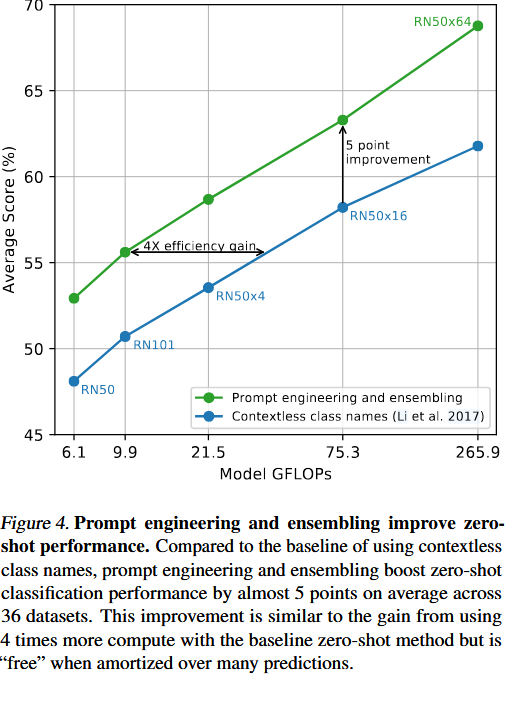
prompt 표현에 따라 성능이 변함
Source: Original
-
fine-grained하거나 특수한 task에서는 supervised model보다 약함
-
web-scale 데이터의 bias를 그대로 학습할 수 있음
-
zero-shot 성능을 높이려면 매우 큰 데이터와 compute가 필요함
-
text로 표현하기 어려운 visual task에는 한계가 있음